
Dionysus: God of Ecstasy, Ruin, and Return
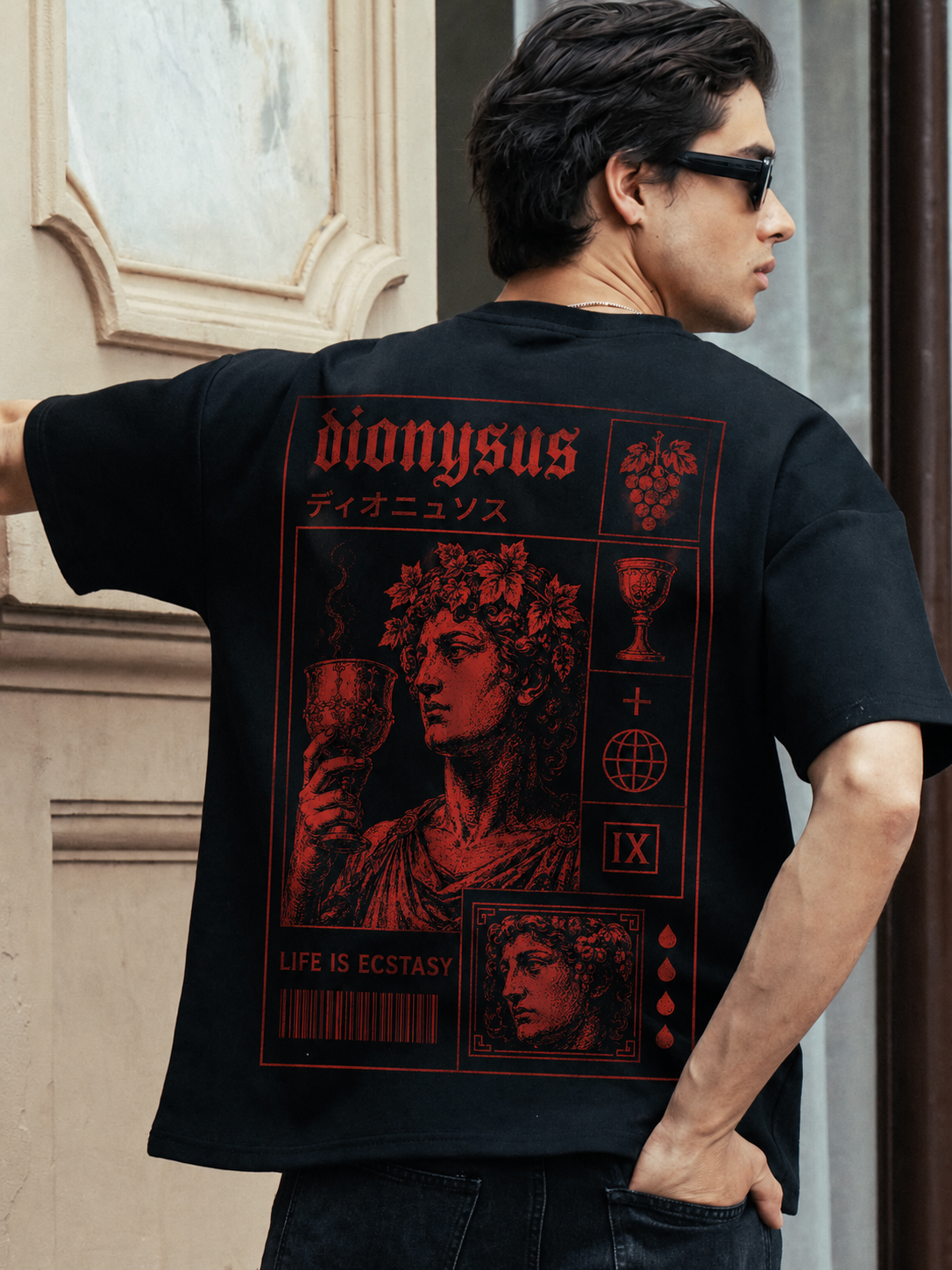
Every god the Greeks made carried a contradiction. Dionysus carried the largest one of all: he was the god of the vine and of the madness that drinks it, of the theatre and of the violence the theatre was built to hold. To wear him is to carry that tension on purpose.
Twice-born
Dionysus is the only Olympian born of a mortal mother. Semele, a princess of Thebes, was loved by Zeus and tricked by a jealous Hera into demanding to see her lover in his true, divine form. No mortal survives the sight of a god undisguised; she burned to nothing. Zeus rescued the unborn child, sewed him into his own thigh, and carried him to term. The Greeks called him dimētōr — “of two mothers” — the god who had already died once before he was born.
Later tradition pushed the wound deeper. In the Orphic myth the infant is seized by the Titans, torn apart, then reassembled and reborn. Dismemberment and return: the vine cut to a black stump every winter, green again every spring. He is the god who is destroyed and comes back anyway.
Ekstasis
Our word “ecstasy” comes from the Greek ékstasis — literally “to stand outside oneself.” That is his true domain: not drunkenness for its own sake, but the deliberate stepping-out — the mask, the festival, the hour you put down the self you manage all day. He is the patron of beautiful loss of control, and the Greeks knew such a thing must be honoured carefully, because it can heal you or tear you apart, often at once.
This is why his cult produced the theatre. The great tragedies of Athens were written for his festival, the City Dionysia; the stage and the mask are his instruments. Euripides’ Bacchae is the warning folded into the worship: King Pentheus tries to ban the god to keep his city orderly and sober, and the god he denies destroys him through his own mother’s hands. The lesson was never “drink.” It is that what you refuse to let move through you will move through you anyway.
Why he opens the capsule
Of the eight figures in this edition, Dionysus is the one we drafted first, because he sets the terms for the rest. Fortitudo is endurance. Memento Mori is mortality. Areté is the pursuit of excellence. Each is a discipline. Dionysus is the reminder that discipline with no release curdles — the loose thread the whole collection is cut around. Restraint only means something next to the thing it restrains.
Oxblood on black
We printed him in oxblood: a red that reads almost black until the light catches it, then glows. It felt true to him — the god you don’t notice until he is already in the room. The portrait sits on heavyweight terry like a torn poster pulled off a back-alley wall, grain and noise intact, because Dionysus was never clean. He was the outsider who arrived from elsewhere and quietly dissolved the rules of wherever he landed.
A graphic tee is a small thing on which to hang a four-thousand-year-old god. But clothing has always been a ritual object — the thing you put on to become a slightly different version of yourself before you walk out the door. That is the most Dionysian act there is.